

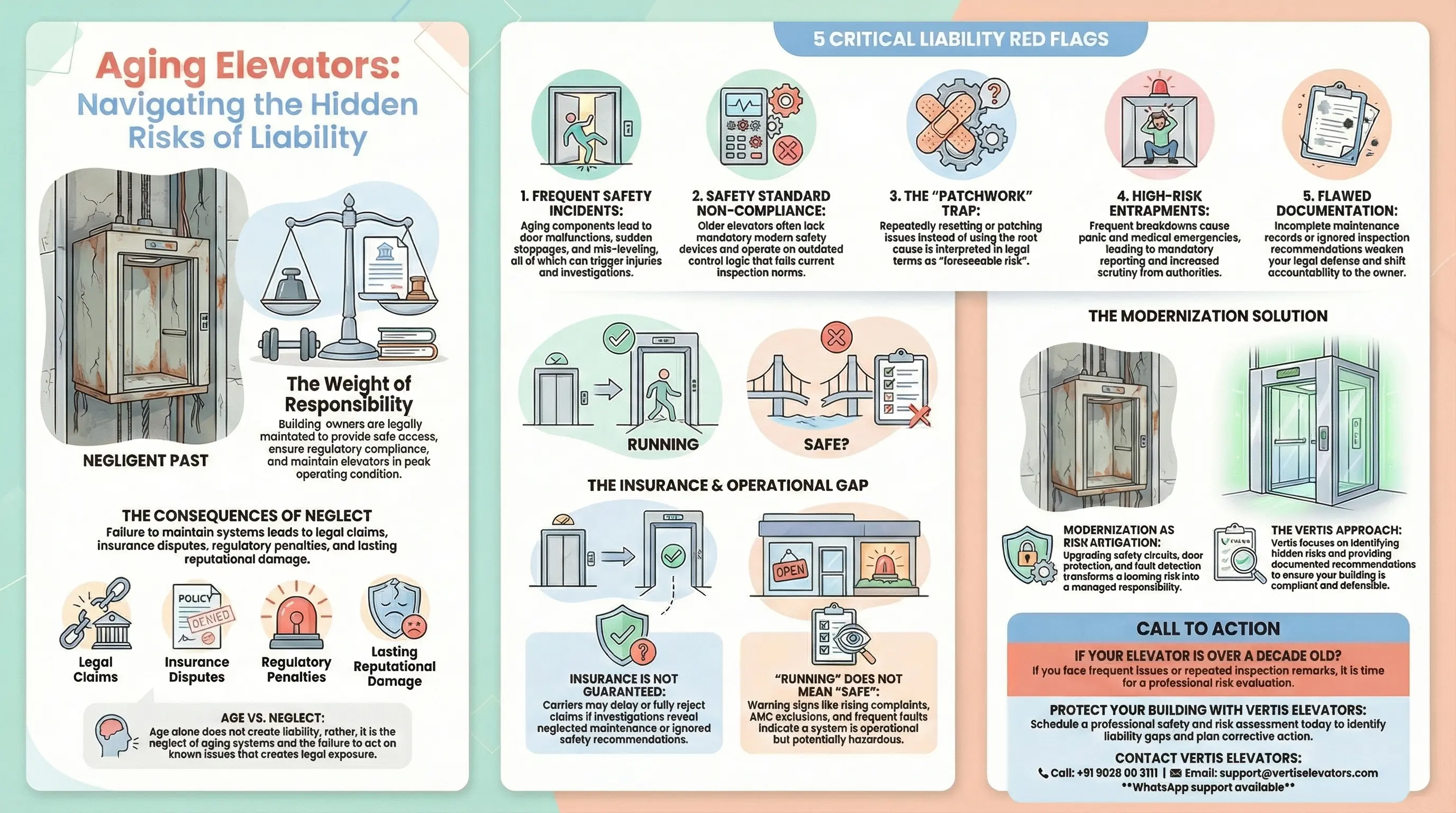
How Aging Elevators Increase Liability for Building Owners
An elevator is not just a convenience—it is a legal responsibility.
As elevators age, the risks associated with their operation grow quietly but steadily. What starts as minor faults or slower performance can eventually expose building owners to serious safety, legal, and financial consequences.
Many liability issues arise not from sudden failures, but from known issues that were tolerated, delayed, or inadequately addressed.
This article explains how aging elevators increase liability, where building owners are most exposed, and what proactive steps can significantly reduce risk.
Understanding Liability in Elevator Operations
Building owners and management bodies are responsible for:
- Providing safe access to occupants and visitors
- Ensuring compliance with applicable safety regulations
- Maintaining elevators in operable and safe condition
Failure in any of these areas can result in:
- Legal claims
- Insurance disputes
- Regulatory penalties
- Reputational damage
Age alone does not create liability—neglect does.
Where Liability Risk Increases as Elevators Age?
1. Higher Probability of Safety Incidents
Aging components are more prone to:
- Door malfunctions
- Sudden stoppages
- Mis-leveling
- Electrical failures
Even minor incidents can:
- Injure users
- Trigger investigations
- Escalate into legal action
2. Non-Compliance with Current Safety Standards
Safety norms evolve.
Older elevators may:
- Lack mandatory safety devices
- Operate on outdated control logic
- Fail to meet inspection requirements
Operating non-compliant equipment—knowingly or unknowingly—exposes owners to direct liability.
3. Repeated Temporary Repairs Instead of Root Solutions
Short-term fixes may restore function, but they do not reduce risk.
When issues are repeatedly:
- Adjusted
- Reset
- Patched
It indicates systemic aging, not isolated faults. In legal terms, this can be interpreted as foreseeable risk.
4. Increased Entrapment and Breakdown Incidents
Entrapments are not just inconvenient—they are high-risk events.
Consequences include:
- Panic and medical emergencies
- Damage to public trust
- Mandatory reporting and scrutiny
A pattern of entrapments significantly strengthens liability claims.
5. Poor Documentation and Maintenance Records
In the event of an incident, authorities often ask:
- Were inspections conducted?
- Were recommendations acted upon?
- Was maintenance preventive or reactive?
Incomplete records weaken defense and shift accountability to the owner.
Insurance Implications of Aging Elevators
Insurance coverage is not unconditional.
Claims may be:
- Delayed
- Partially denied
- Fully rejected
If investigations reveal:
- Neglected maintenance
- Ignored safety recommendations
- Non-compliance with regulations
Aging elevators without proactive management increase insurance risk exposure.
The Hidden Cost of “Operational” but Unsafe Elevators
An elevator that still runs is not necessarily safe.
Warning signs often include:
- Rising complaints
- Frequent faults
- Increasing AMC exclusions
- Temporary inspection approvals
Ignoring these signs increases the risk of being held responsible after an incident occurs.
How Proactive Action Reduces Liability?
Liability reduces dramatically when owners:
- Adopt preventive maintenance
- Address aging-related risks early
- Modernize critical safety systems
- Maintain transparent documentation
- Act on professional recommendations
Modernization is often not just technical—it is risk mitigation.
Modernization as a Liability Management Tool
Targeted modernization can:
- Upgrade safety circuits
- Improve door protection systems
- Enhance fault detection
- Align elevators with current norms
This transforms liability from a looming risk into a managed responsibility.
The Vertis Elevators Perspective
At Vertis Elevators, we view elevator safety through both technical and legal lenses.
Our approach focuses on:
- Identifying hidden liability risks
- Ensuring compliance readiness
- Providing clear, documented recommendations
- Prioritizing occupant safety over temporary operation
Because avoiding failure is not enough—you must be able to demonstrate responsibility.
The Final Words
If your elevator is
- Over a decade old
- Experiencing frequent issues
- Operating on outdated systems
- Receiving repeated inspection remarks
It may be exposing your building to unnecessary liability.
Vertis Elevators offers professional elevator safety and risk assessments to help building owners:
- Identify liability gaps
- Plan corrective action
- Protect occupants
- Reduce legal and insurance exposure
Schedule a professional elevator risk evaluation with Vertis Elevators and ensure your building’s vertical transport is safe, compliant, and defensible.
Call: +91 9028 00 3111 | WhatsApp Support Available
Email: support@vertiselevators.com
Related Post
Safety Can’t Wait.
Book a free safety audit with Vertis Elevators and ensure your building meets every standard - protecting people and your reputation.
Leave a Comment



Comments (0)
No comments available.