

Elevator AMC Explained: What You’re Really Paying For (and What You’re Not)
An Elevator AMC (Annual Maintenance Contract) is one of the most misunderstood agreements in building management.
Most people assume:
“AMC means the elevator is fully taken care of.”
In reality, many AMCs look similar on paper, but differ drastically in:
- What they actually cover
- How risks are handled
- How breakdowns are prevented (or not)
- Who ultimately bears the cost
This guide explains—clearly and honestly—what an elevator AMC really includes, what it often excludes, and how to choose one that protects your building instead of exposing it to hidden risks.
What Is an Elevator AMC? — In Simple Terms
An Elevator AMC is a service agreement that defines:
- Scope of maintenance
- Frequency of visits
- Response time during breakdowns
- Responsibility for parts and labour
- Safety and compliance obligations
But here’s the key truth:
Not all AMCs are designed to protect the elevator.
Some are designed only to keep it running—until it doesn’t.
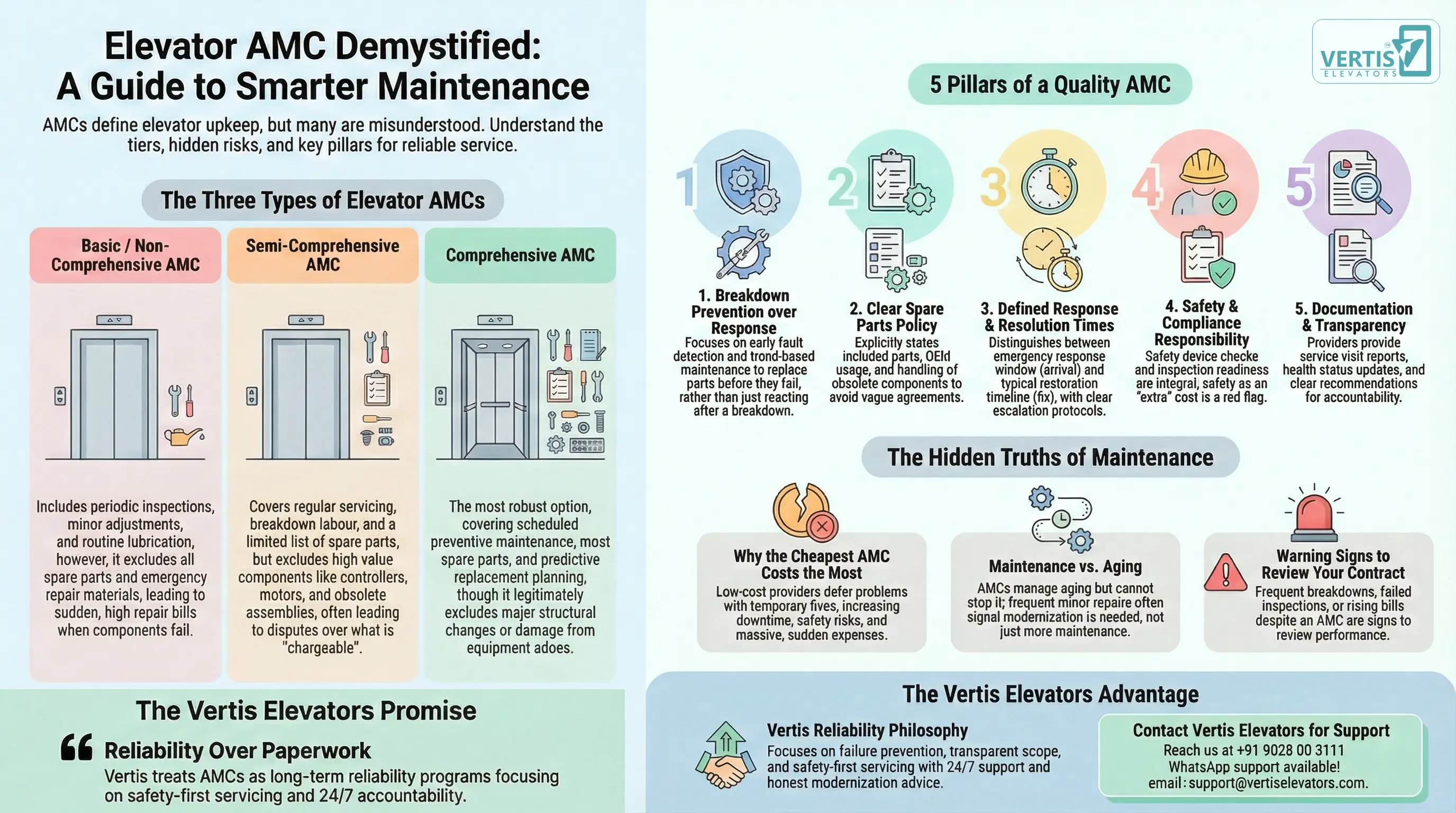
The 3 Common Types of Elevator AMCs
Understanding these categories is critical before signing anything.
1. Basic / Non-Comprehensive AMC
What it usually includes:
- Periodic inspections
- Minor adjustments
- Basic lubrication
- Labour for routine servicing
What it usually excludes:
- Spare parts
- Major components
- Emergency repair materials
- Wear-and-tear replacements
Best suited for:
- New elevators under warranty
- Low-usage buildings (with caution)
Hidden risk: Repair bills can spike suddenly when parts fail.
2. Semi-Comprehensive AMC
What it includes:
- Regular servicing
- Labour for breakdowns
- Selected spare parts (limited list)
What it excludes:
- High-value components (controllers, motors, drives)
- Obsolete or imported parts
- Major electrical assemblies
Best suited for:
- Mid-age elevators
- Buildings with moderate usage
Hidden risk: Grey areas—what’s “included” vs “chargeable” often leads to disputes.
3. Comprehensive AMC
What it includes:
- Scheduled preventive maintenance
- Labour + most spare parts
- Emergency breakdown support
- Predictive replacement planning
- Safety checks and reporting
What may still be excluded (legitimately):
- Major modernization work
- Structural or civil changes
- Abuse or misuse damage
Best suited for:
- High-traffic buildings
- Hospitals, malls, factories
- Older elevators needing stability
Hidden risk (if poorly written): Over-promising without execution capability.
What a Good AMC Should Actually Deliver?
Regardless of type, a quality AMC must focus on outcomes, not just visits.
1. Breakdown Prevention, Not Breakdown Response
If the AMC only activates after failure, it’s reactive by design.
A strong AMC emphasizes:
- Early fault detection
- Trend-based maintenance
- Replacement before failure
2. Clear Spare Parts Policy
Ask:
- Which parts are included?
- Are OEM or equivalent parts used?
- What happens when parts become obsolete?
Vague answers = future surprises.
3. Defined Response & Resolution Time
Response time ≠ fix time.
A professional AMC clearly defines:
- Emergency response window
- Typical restoration timelines
- Escalation protocols
4. Safety & Compliance Responsibility
A proper AMC should include:
- Safety device checks
- Compliance assistance
- Inspection readiness
If safety is “extra,” that’s a red flag.
5. Documentation & Transparency
You should receive:
- Service visit reports
- Observations & recommendations
- Health status of critical components
No documentation = no accountability.
What Most AMCs Don’t Tell You (But Should)
- AMCs do not stop aging—they manage it
- Cheap AMCs often defer problems, not solve them
- Frequent minor repairs often signal modernization need
- An AMC cannot compensate for obsolete technology
A responsible service provider will tell you when: “Maintenance alone is no longer enough.”
Why the Cheapest AMC Often Costs the Most?
Low-cost AMCs usually:
- Reduce visit quality
- Use temporary fixes
- Avoid proactive replacements
- Depend on emergency repairs
The cost shows up later as:
- Downtime
- Safety risks
- Large, sudden expenses
How to Choose the Right AMC for Your Building?
Before signing, ask these questions:
- Is this AMC preventive or reactive by design?
- What components are realistically covered?
- How are aging and obsolescence handled?
- What documentation will we receive?
- When will modernization be recommended?
If answers are unclear, reconsider.
The Vertis Elevators AMC Philosophy
At Vertis Elevators, we treat AMCs as long-term reliability programs, not annual paperwork.
Our approach focuses on:
- Preventing failures, not normalizing them
- Transparent scope definitions
- Safety-first servicing
- Honest modernization advice when required
- 24×7 support with accountability
Because a good AMC should reduce anxiety, not create it.
Before You Renew or Sign Your Next AMC
If your elevator:
- Breaks down frequently
- Feels unreliable despite an AMC
- Generates rising repair bills
- Fails inspections repeatedly
It’s time to review the contract, not just renew it.
An informed AMC decision today prevents operational and safety crises tomorrow.
Call: +91 9028 00 3111 | WhatsApp Support Available
Email: support@vertiselevators.com
Related Post

Safety Can’t Wait.
Book a free safety audit with Vertis Elevators and ensure your building meets every standard - protecting people and your reputation.
Leave a Comment



Comments (0)
No comments available.