

Controller Modernization: The Brain Upgrade Your Elevator Needs
Controller Modernization: The Brain Upgrade Your Elevator Needs
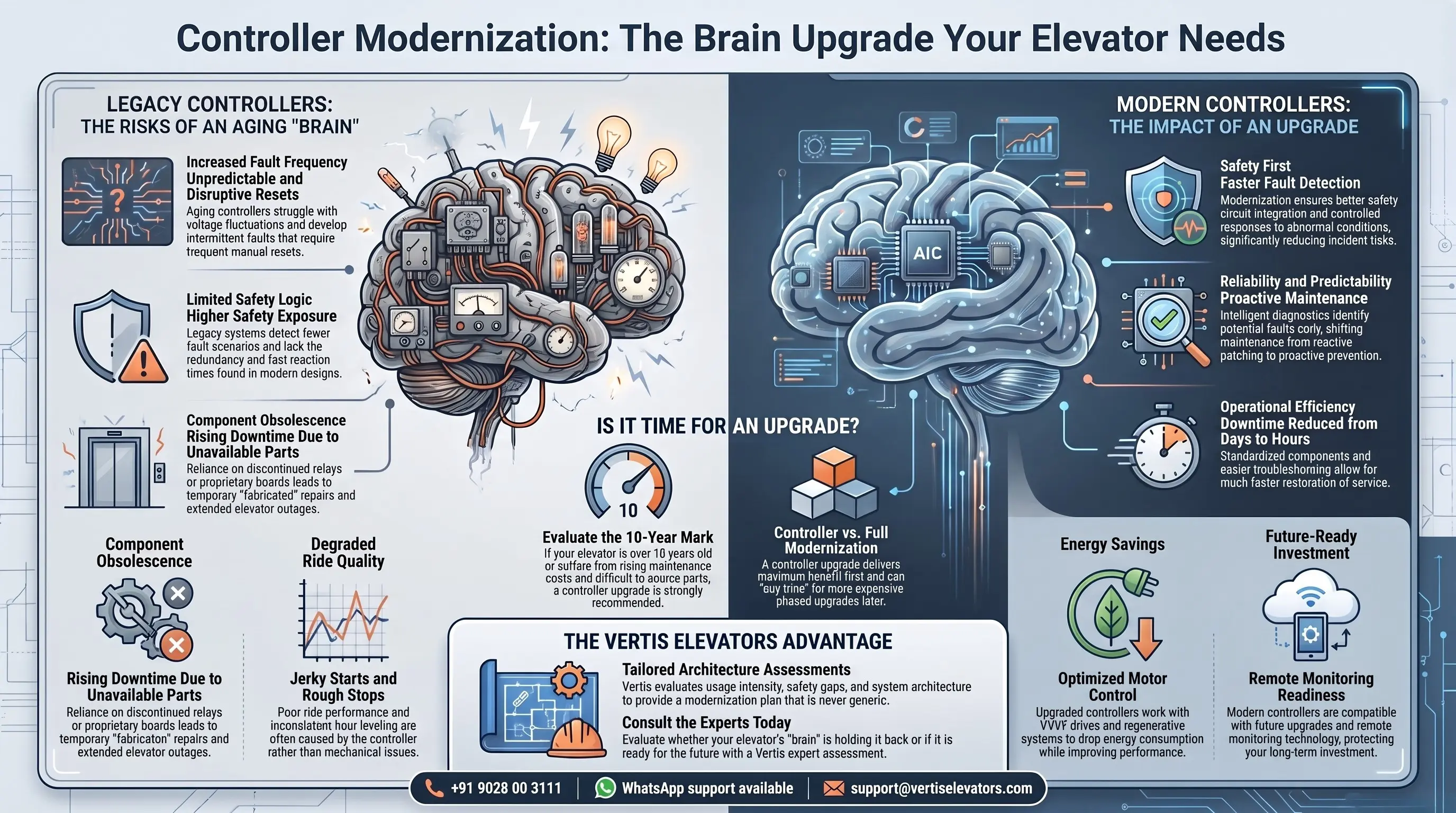
If an elevator were a human body, the controller would be the brain.
It decides:
- When the elevator moves
- How smoothly it accelerates and stops
- How doors behave
- How faults are detected and handled
- How safely the system responds to abnormal conditions
Yet, controller upgrades are often delayed because the elevator still “seems to work.”
This article explains why controller modernization delivers the highest impact on safety, reliability, and performance; and also explains why it is often the smartest first step in elevator modernization.
What Is an Elevator Controller? (In Simple Terms)
The controller is the central command unit that:
- Interprets calls from floors and cabin buttons
- Controls motor speed and direction
- Monitors safety circuits
- Detects faults and initiates protective actions
Older controllers rely on:
- Relay-based logic
- Obsolete electronics
- Limited fault diagnostics
Modern controllers use:
- Microprocessor-based systems
- Intelligent diagnostics
- Advanced safety logic
The difference is not subtle—it is foundational.
Why Aging Controllers Become a Risk
As controllers age, several issues emerge:
1. Increased Fault Frequency
Older controllers:
- Struggle with voltage fluctuations
- Develop intermittent faults
- Require frequent resets
These faults are often unpredictable and disruptive.
2. Limited Safety Logic
Legacy systems:
- Detect fewer fault scenarios
- React slower to abnormal conditions
- Lack redundancy found in modern designs
This increases safety exposure, especially in high-traffic buildings.
3. Spare Parts Become Obsolete
Many older controllers depend on:
- Discontinued relays
- Proprietary boards
- Unavailable components
This leads to:
- Temporary repairs
- Fabricated solutions
- Increased downtime
4. Poor Ride Quality and Performance
Jerky starts, rough stops, and inconsistent leveling are often controller-related, not mechanical.
Modern controllers dramatically improve:
- Smoothness
- Accuracy
- Passenger comfort
What Controller Modernization Actually Improves?
1. Safety First
Modern controllers offer:
- Faster fault detection
- Better safety circuit integration
- Controlled responses to abnormal conditions
This significantly reduces the risk of incidents.
2. Reliability and Predictability
With modern diagnostics:
- Faults are identified early
- Maintenance becomes proactive
- Sudden failures reduce drastically
Reliability is restored, not patched.
3. Reduced Downtime
Modern systems:
- Are easier to troubleshoot
- Use standardized components
- Allow faster restoration
Downtime shifts from days to hours.
4. Energy Efficiency
Controller upgrades often work with:
- VVVF drives
- Regenerative systems
- Optimized motor control
Energy consumption drops while performance improves.
5. Future-Ready Integration
Modern controllers allow:
- Remote monitoring readiness
- Easier modernization of other components
- Compatibility with future upgrades
This protects long-term investment.
When Should You Consider Controller Modernization?
Controller modernization is strongly recommended if:
- The elevator is over 10 years old
- Faults are frequent but inconsistent
- Spare parts are difficult to source
- Ride quality has degraded
- Maintenance costs are rising
In many cases, modernizing the controller alone resolves most operational issues.
Controller Modernization vs. Full Modernization
Not every elevator needs full modernization immediately.
Controller upgrades often:
- Deliver maximum benefit first
- Reduce urgent failures
- Buy time for phased upgrades
This makes them a strategic starting point.
Why Controller Upgrades Must Be Professionally Engineered
Poorly executed controller modernization can:
- Create system incompatibility
- Introduce safety gaps
- Increase maintenance complexity
A proper upgrade requires:
- System compatibility assessment
- Safety circuit integration
- Testing and validation
- Documentation and training
The Vertis Elevators Approach
At Vertis Elevators, controller modernization is never generic.
We evaluate:
- Existing system architecture
- Usage intensity
- Safety gaps
- Future modernization plans
Our upgrades are designed to:
- Restore reliability
- Enhance safety
- Improve performance
- Support long-term serviceability
Because the brain of your elevator must be as dependable as the structure itself.
The Final Words
If your elevator:
- Suffers frequent unexplained faults
- Feels unreliable despite regular maintenance
- Operates on outdated control technology
A controller upgrade may be the most effective modernization decision you can make.
Vertis Elevators provides expert controller assessments and modernization solutions tailored to your building’s usage, safety requirements, and budget.
Consult Vertis Elevators today to evaluate whether your elevator’s “brain” is holding it back—or ready for the future.
Call: +91 9028 00 3111 | WhatsApp Support Available
Email: support@vertiselevators.com
Related Post
Safety Can’t Wait.
Book a free safety audit with Vertis Elevators and ensure your building meets every standard - protecting people and your reputation.
Leave a Comment



Comments (0)
No comments available.