

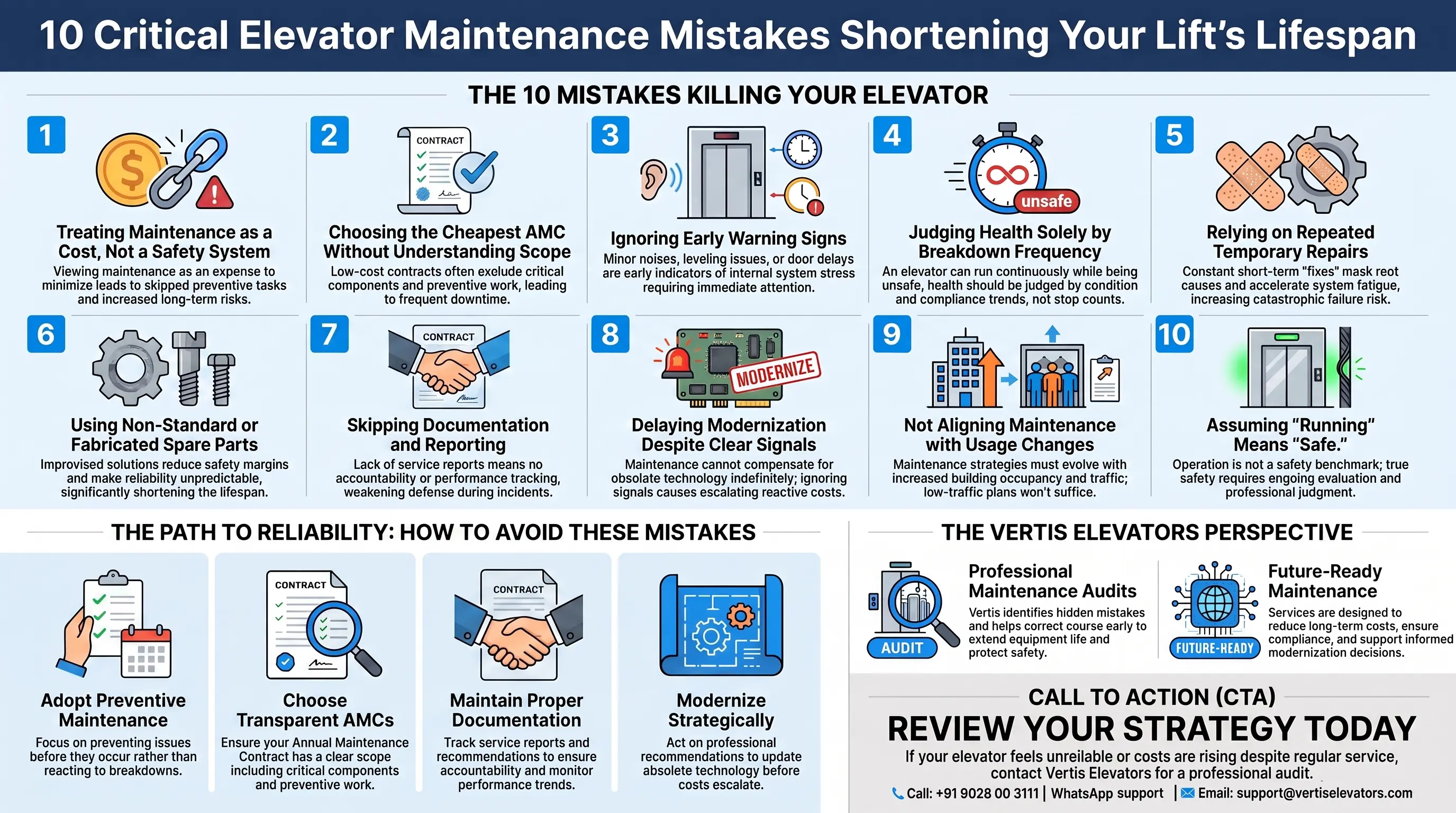
Common Elevator Maintenance Mistakes That Shorten Its Lifespan
Most elevators don’t fail because they are badly designed.
They fail because they are maintained the wrong way for too long.
Many buildings spend money on maintenance every year—yet still face frequent breakdowns, rising costs, and premature modernization. The reason is not always lack of maintenance, but avoidable mistakes in how maintenance is planned, evaluated, and executed.
This article highlights the most common elevator maintenance mistakes that quietly shorten elevator lifespan—and how to avoid them.
1. Treating Maintenance as a Cost, Not a Safety System
When maintenance is viewed only as an expense to be minimized:
- Preventive tasks get skipped
- Quality of service drops
- Long-term risks increase
Elevator maintenance is not optional upkeep—it is a safety-critical system.
2. Choosing the Cheapest AMC Without Understanding Scope
Low-cost AMCs often:
- Limit preventive work
- Exclude critical components
- Encourage temporary fixes
What appears affordable annually can become expensive when:
- Emergency repairs increase
- Downtime becomes frequent
- Major failures occur earlier than expected
3. Ignoring Early Warning Signs
Common warnings are often dismissed:
- Minor noises
- Occasional leveling issues
- Slight delays
- Intermittent door problems
These are not “normal aging”—they are early indicators of wear or system stress.
4. Relying Only on Breakdown Frequency
Many buildings judge elevator health by asking: “How many times did it stop last month?”
This is misleading.
A system can:
- Run continuously
- Still be unsafe, inefficient, or deteriorating internally
Health must be judged by condition, trends, and compliance, not just breakdown counts.
5. Repeated Temporary Repairs
Adjustments, resets, and short-term fixes may restore operation, but:
- Do not address root causes
- Increase future failure probability
- Mask the need for modernization
Temporary fixes repeated over time accelerate system fatigue.
6. Using Non-Standard or Fabricated Spare Parts
When original or equivalent parts are unavailable:
- Improvised solutions are sometimes used
- Safety margins reduce
- Reliability becomes unpredictable
This practice significantly shortens component and system lifespan.
7. Skipping Documentation and Reporting
Maintenance without documentation is invisible.
Lack of:
- Service reports
- Observations
- Recommendations
Means:
- No accountability
- No performance tracking
- Weak defense in case of incidents
8. Delaying Modernization Despite Clear Signals
Maintenance cannot compensate for obsolete technology indefinitely.
When modernization signals are ignored:
- Maintenance becomes reactive
- Failures cluster
- Costs escalate suddenly
Timely modernization extends lifespan. Delayed modernization shortens it.
9. Not Aligning Maintenance with Usage Changes
Buildings evolve:
- More occupants
- Higher traffic
- Extended operating hours
Maintenance strategies must evolve too. What worked earlier may no longer be sufficient.
10. Assuming “Running” Means “Safe”
An elevator that operates is not automatically safe, compliant, or reliable.
Safety requires:
- Ongoing evaluation
- Preventive intervention
- Professional judgment
Operation alone is not the benchmark.
How to Avoid These Mistakes?
Buildings that maximize elevator lifespan usually:
- Adopt preventive maintenance
- Choose transparent AMCs
- Act on professional recommendations
- Modernize strategically
- Maintain proper documentation
The goal is not zero breakdowns—it is controlled aging and predictable performance.
The Vertis Elevators Perspective
At Vertis Elevators, maintenance is designed to:
- Extend equipment life
- Reduce long-term costs
- Protect safety and compliance
- Support informed modernization decisions
Because good maintenance doesn’t just keep elevators running—it keeps them reliable, safe, and future-ready.
The Final Words
If your elevator:
- Requires frequent adjustments
- Shows recurring minor faults
- Has rising maintenance costs
- Feels unreliable despite regular servicing
It may be suffering from maintenance approach issues, not just equipment aging.
Vertis Elevators offers professional maintenance audits to help buildings identify hidden mistakes, correct course early, and extend elevator lifespan responsibly.
Consult Vertis Elevators to review your current maintenance strategy and ensure your elevator is being cared for the right way.
???? Call: +91 9028 zero zero 3111 | ???? WhatsApp Support Available
???? Email: support@vertiselevators.com
Related Post
Safety Can’t Wait.
Book a free safety audit with Vertis Elevators and ensure your building meets every standard - protecting people and your reputation.
Leave a Comment



Comments (0)
No comments available.