

Smart Elevators: How IoT Is Transforming Vertical Mobility
For decades, elevators were mechanical systems that reacted only when something went wrong. A breakdown would occur, a complaint would be raised, and technicians would respond.
Today, that reactive model is rapidly becoming obsolete.
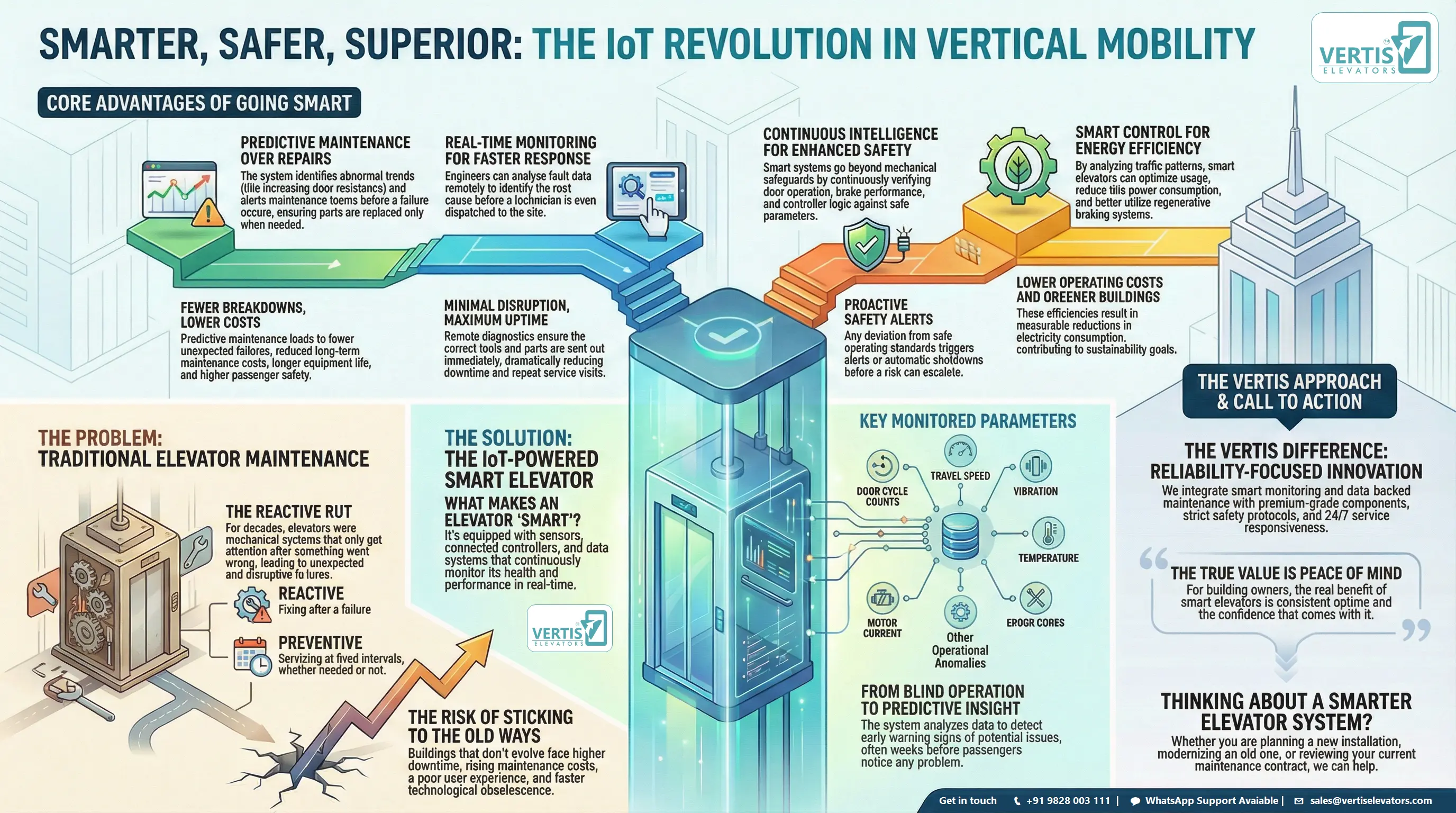
With the integration of Internet of Things (IoT) technologies, elevators are evolving into intelligent, self-monitoring systems—capable of predicting failures, optimizing performance, and significantly improving safety and uptime.
This shift is not just a technological upgrade. It is fundamentally changing how buildings operate.
What Makes an Elevator “Smart”?
A smart elevator is equipped with sensors, connected controllers, and data communication systems that continuously monitor its health and performance.
These systems track parameters such as:
- Door cycle counts and door motor load
- Travel speed, acceleration, and braking patterns
- Vibration, temperature, and motor current
- Error codes and operational anomalies
This data is transmitted to centralized platforms where it is analyzed in real time.
Instead of waiting for a failure, the system detects early warning signs, often weeks before passengers experience any issue.
In practice, this means elevators no longer operate blindly.
From Breakdown Repairs to Predictive Maintenance
Traditional elevator maintenance follows either:
- Reactive maintenance (fix it after it fails), or
- Preventive maintenance (service it at fixed intervals)
IoT enables a third, far superior model: predictive maintenance.
How predictive maintenance works?
- The system identifies abnormal trends (e.g., increasing door resistance)
- Maintenance teams are alerted before failure occurs
- Parts are serviced or replaced only when actually needed
The result:
- Fewer unexpected breakdowns
- Reduced maintenance costs over time
- Longer equipment life
- Higher passenger safety and confidence
For industrial facilities, hospitals, and commercial complexes, this translates directly into operational reliability.
Real-Time Monitoring = Faster Response
One of the biggest advantages of smart elevators is remote diagnostics.
When an issue arises:
- Engineers can analyze fault data remotely
- Root causes are identified before technicians reach site
- Correct tools and parts are dispatched immediately
This dramatically reduces:
- Downtime
- Trial-and-error repairs
- Repeat service visits
For building owners, this means faster resolution and minimal disruption, especially critical in factories, healthcare facilities, and high-footfall commercial spaces.
Improved Safety Through Continuous Intelligence
Safety in elevators is no longer limited to mechanical safeguards alone.
Smart systems continuously verify:
- Door operation integrity
- Brake performance
- Overspeed protection behavior
- Controller logic consistency
Any deviation from safe operating parameters triggers alerts or automatic shutdowns before risk escalates.
This proactive safety layer aligns with modern international safety standards and is becoming increasingly relevant as regulatory expectations rise.
Energy Efficiency Through Smart Control
IoT-driven elevators are also more energy-efficient.
By analyzing usage patterns:
- Traffic flow is optimized
- Idle power consumption is reduced
- Regenerative braking systems are better utilized
In large commercial and industrial buildings, these efficiencies lead to measurable reductions in electricity consumption, contributing to sustainability goals and lower operating costs.
Why Smart Elevators Matter More in India Today?
India’s urban landscape is changing rapidly:
- Taller buildings
- Higher occupancy densities
- Increased safety expectations
- Growing focus on lifecycle costs, not just installation price
Smart elevators are no longer a luxury, they are becoming a practical necessity for future-ready buildings.
Buildings that ignore this shift risk:
- Higher downtime
- Rising maintenance costs
- Poor user experience
- Faster technological obsolescence
The Vertis Perspective
At Vertis Elevators, technology is not adopted for novelty, it is implemented for measurable reliability, safety, and service speed.
Smart monitoring, data backed maintenance planning, and modern control systems are integrated with:
- Premium-grade components
- Strict safety protocols
- 24×7 service responsiveness
This ensures that innovation directly translates into real-world performance, not just technical specifications.
For building owners and facility managers, the true value of smart elevators lies not in sensors or software, but in consistent uptime and peace of mind.
Thinking About Smarter Elevator Systems?
If you are:
- Planning a new installation
- Evaluating modernization options
- Reviewing your current AMC effectiveness
Understanding how smart elevator technologies fit into your specific use case is crucial.
A structured technical assessment from Vertis engineer can help determine what level of intelligence actually delivers value—without unnecessary complexity.
Call: +91 9028 00 3111
(WhatsApp Support Available)
Email: support@vertiselevators.com
Related Post

Safety Can’t Wait.
Book a free safety audit with Vertis Elevators and ensure your building meets every standard - protecting people and your reputation.
Leave a Comment




Comments (0)
No comments available.