

Predictive Maintenance vs Preventive Maintenance: What Modern Elevators Really Need?
If you own or manage a building, you’ve probably heard this line before:
“Sir, everything looks fine now; we are doing regular maintenance.”
And yet…
The elevator still breaks down unexpectedly.
Tenants still complain.
Production still gets disrupted.That’s because not all maintenance models are created equal.
In today’s elevator ecosystem, the real question is no longer whether you maintain your elevators, but how intelligently you maintain them.
Understanding the Two Maintenance Models (In Simple Terms)
Before choosing sides, let’s clearly understand what each approach actually means, without technical jargon.
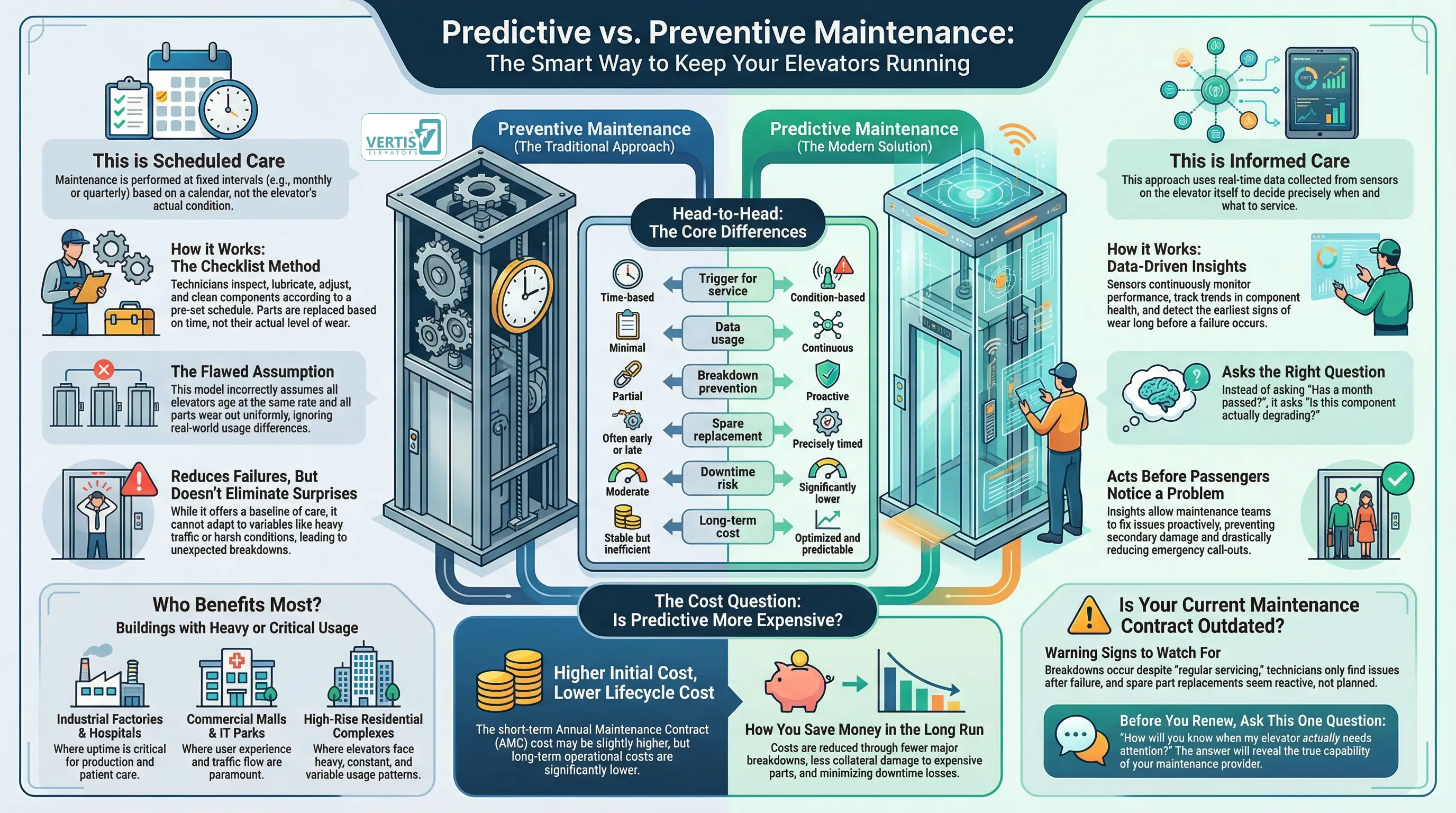
1. What Is Preventive Maintenance?
Preventive maintenance is the traditional model most buildings follow.
How it works?
- Maintenance is scheduled at fixed intervals (monthly, quarterly, etc.)
- Technicians inspect, lubricate, adjust, and clean components
- Parts are serviced or replaced based on time, not condition
The idea behind it:
“If we service everything regularly, breakdowns won’t happen.”
The reality:
It reduces failures, but it does not eliminate surprises.
2. What Is Predictive Maintenance?
Predictive maintenance uses real-time data from the elevator itself to decide when and what to service.
How it works:
- Sensors continuously monitor elevator performance
- The system tracks trends, not just faults
- Early signs of wear are detected long before failure
Instead of asking:
“Has one month passed?”
It asks:
“Is this component actually degrading?”
The Core Difference (That Most People Miss)
|
Aspect |
Preventive Maintenance |
Predictive Maintenance |
|
Trigger for service |
Time-based |
Condition-based |
|
Data usage |
Minimal |
Continuous |
|
Breakdown prevention |
Partial |
Proactive |
|
Spare replacement |
Often early or late |
Precisely timed |
|
Downtime risk |
Moderate |
Significantly lower |
|
Long-term cost |
Stable but inefficient |
Optimized and predictable |
- Preventive maintenance is scheduled care.
- Predictive maintenance is informed care.
Why Preventive Maintenance Still Falls Short?
Preventive maintenance assumes:
- All elevators age at the same rate
- All components wear uniformly
- Usage patterns remain constant
But in reality:
- A hospital elevator runs very differently from a residential one
- A factory elevator faces heavier loads and harsher conditions
- Traffic varies by time, season, and user behavior
Time-based servicing simply cannot adapt to these variables.
How Predictive Maintenance Changes the Game?
Predictive systems monitor:
- Door motor load and cycle fatigue
- Brake performance consistency
- Motor temperature and vibration
- Controller error trends
- Ride quality deviations
These insights allow maintenance teams to:
- Act before passenger’s experience issues
- Prevent secondary damage caused by ignored early faults
- Reduce emergency call-outs
For building owners, this means:
- Fewer angry calls
- Better uptime
- More predictable maintenance budgets
Does Predictive Maintenance Mean Higher Cost?
This is a common concern, and a valid one.
The truth is:
- Short-term AMC costs may be slightly higher
- Long-term operational costs are significantly lower
Why?
- Fewer major breakdowns
- Less collateral damage to expensive components
- Reduced downtime losses (especially critical in factories and hospitals)
Over the lifecycle of an elevator, predictive maintenance almost always proves more economical.
Which Buildings Benefit the Most from Predictive Maintenance?
Predictive maintenance delivers maximum value in:
- Industrial factories
- Hospitals and healthcare facilities
- Commercial malls and IT parks
- High-rise residential complexes
- Elevators with heavy or variable usage
Smaller, low-usage buildings may still function adequately with preventive maintenance, for now.
The Hybrid Reality (That Actually Works Best!)
In practice, the smartest approach is not either/or.
Modern elevator maintenance works best when:
- Preventive maintenance ensures baseline safety
- Predictive systems guide critical interventions
This hybrid model ensures:
- Compliance with safety standards
- Intelligent resource allocation
- Maximum equipment lifespan
The Vertis Approach to Maintenance
At Vertis Elevators, maintenance is not treated as a routine checklist. It is treated as a living system.
By combining:
- Modern monitoring tools
- Skilled engineering judgment
- Structured service protocols
- 24×7 response readiness
Maintenance decisions are driven by data, safety priorities, and real usage patterns, not assumptions.
The goal is simple: prevent failures before users even sense a problem.
How to Know If Your Current AMC Is Outdated?
You may still be operating under an older maintenance model if:
- Breakdowns occur despite “regular servicing”
- Technicians discover issues only after failure
- Spare replacements feel reactive, not planned
- Downtime explanations remain vague
These are signals, not accidents.
Before Renewing Your AMC, Ask This
Instead of asking:
“How often will you visit?”
Ask:
“How will you know when my elevator actually needs attention?”
That single question reveals the true maturity of a maintenance provider.
Call: +91 9028 00 3111
(WhatsApp Support Available)
Email: support@vertiselevators.com
Related Post

Safety Can’t Wait.
Book a free safety audit with Vertis Elevators and ensure your building meets every standard - protecting people and your reputation.
Leave a Comment



Comments (0)
No comments available.