

How Remote Monitoring Is Changing Elevator AMC Models
Not long ago, elevator maintenance contracts were simple.
A technician would visit once a month, tick a checklist, and leave. If something failed in between, a complaint would be logged and a breakdown call raised. That was considered normal.
Today, that model feels increasingly outdated.
With remote monitoring, elevators no longer wait for human attention. They speak for themselves; quietly, continuously, and long before passengers notice a problem.
This shift is redefining what an AMC (Annual Maintenance Contract) actually means.
What Is Remote Monitoring in Elevators?
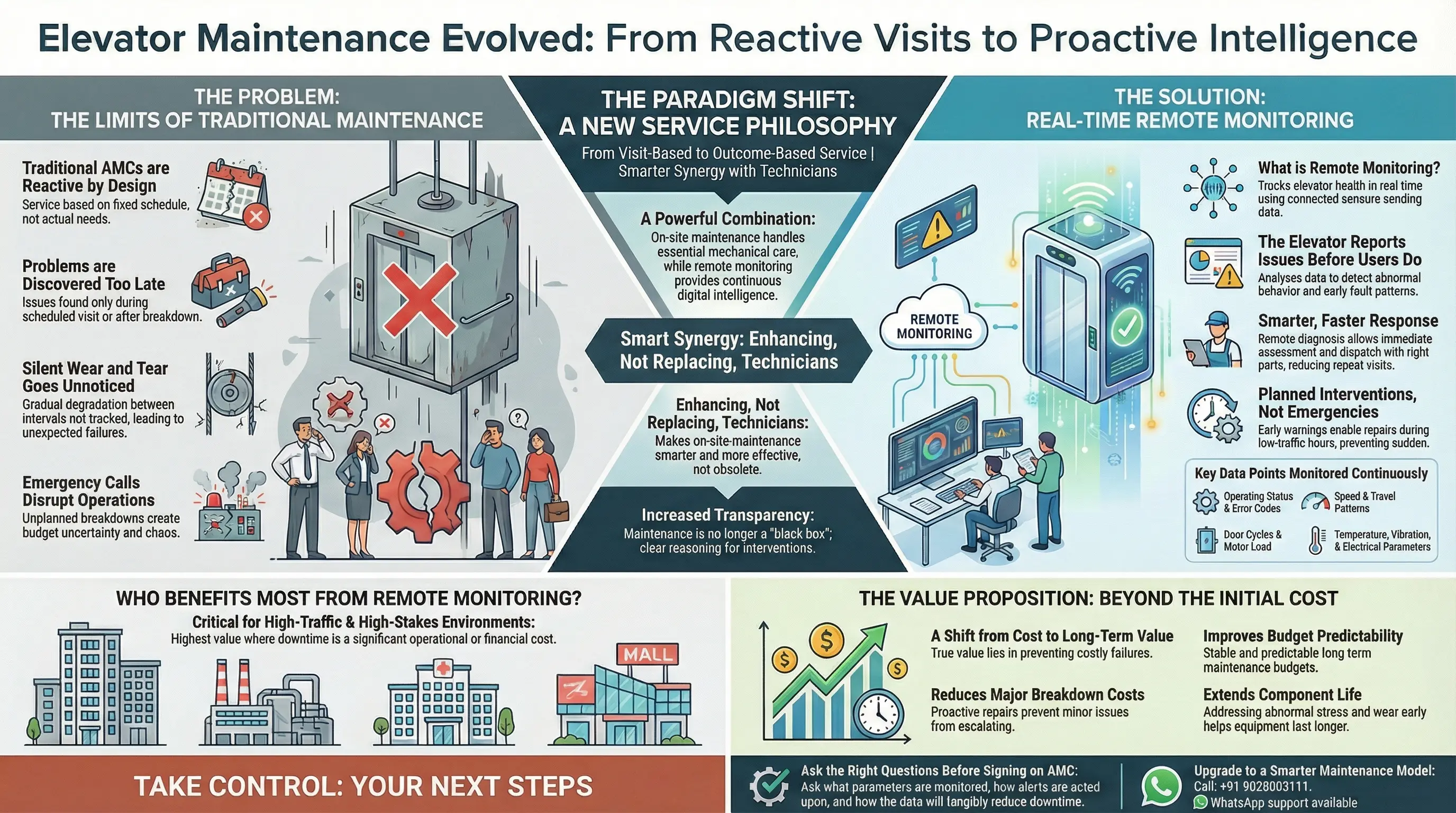
Remote monitoring is the ability to track an elevator’s health in real time using connected sensors and communication systems.
Instead of relying only on physical visits, the elevator continuously sends data such as:
- Operating status and error codes
- Door cycles and motor load
- Speed, travel patterns, and stops
- Temperature, vibration, and electrical parameters
This data is monitored remotely by service teams and analyzed to detect abnormal behavior and early fault patterns.
In simple terms: The elevator reports issues before users experience them.
The Traditional AMC Model: Why It’s Being Challenged
Traditional AMCs are built around scheduled visits, not actual condition.
Their limitations:
- Problems are discovered only during visits or after breakdowns
- Wear between service intervals goes unnoticed
- Emergency calls disrupt operations and budgets
- Root causes are often identified late
Even with skilled technicians, this model remains reactive by design.
Remote monitoring changes that foundation entirely.
How Remote Monitoring Reshapes AMC Expectations?
Remote monitoring doesn’t just improve maintenance; it changes the contract philosophy.
1. From Visit-Based to Outcome-Based Service
Instead of measuring: “How many visits were done?”
The focus shifts to: “How much downtime was prevented?”
2. Faster, Smarter Response
When an alert is triggered:
- Engineers diagnose remotely
- Fault severity is assessed immediately
- Technicians arrive prepared with the right parts
This reduces repeat visits and trial-and-error repairs.
3. Planned Interventions Instead of Emergencies
Early warnings allow:
- Repairs during low-traffic hours
- Controlled shutdowns instead of sudden failures
- Better coordination with facility teams
For hospitals, factories, and malls, this predictability is critical.
What Changes for Building Owners and Facility Managers
Remote monitoring shifts the owner’s experience in very real ways.
You notice:
- Fewer breakdown calls
- Less passenger frustration
- More transparency in maintenance decisions
- Clear reasoning behind part replacements
Maintenance stops feeling like a black box.
Does Remote Monitoring Replace On-Site Maintenance?
No, and this is an important clarification.
Remote monitoring does not eliminate physical servicing.
It makes physical servicing smarter.
Think of it this way:
- On-site maintenance handles mechanical care
- Remote monitoring provides continuous intelligence
The strongest AMC models combine both.
Which Buildings Benefit the Most from Remote Monitoring?
Remote monitoring delivers the highest value in:
- Industrial facilities with continuous operations
- Hospitals and healthcare buildings
- High-rise residential societies
- Commercial complexes with peak-hour traffic
- Elevators critical to logistics or accessibility
For such buildings, downtime is not just inconvenient, it is costly.
How Remote Monitoring Impacts AMC Pricing? (The Honest View)
Remote-enabled AMCs may appear slightly premium at first glance.
However, over time they:
- Reduce major breakdown costs
- Extend component life
- Lower disruption-related losses
- Improve long-term budget predictability
The value lies not in fewer visits, but in fewer failures.
Remote Monitoring Is Not the Future. It Is the Present.
Buildings that still rely purely on time-based servicing are already behind the curve.
As elevators become more intelligent, maintenance models must evolve with them.
Remote monitoring is not about complexity, it is about clarity, control, and continuity.
The Vertis Approach to Remote-Enabled AMC
At Vertis Elevators, remote monitoring is treated as a decision-support tool, not a marketing add-on.
It is used to:
- Prioritize safety-critical alerts
- Plan interventions before failures escalate
- Support technicians with accurate diagnostics
- Improve service response speed
Combined with 24×7 support readiness and structured maintenance protocols, this approach ensures that technology directly enhances reliability.
The objective is not to watch elevators, but to protect them.
Questions to Ask Before Signing Your Next AMC
If remote monitoring is being offered, ask:
- What parameters are actually monitored?
- How are alerts classified and acted upon?
- Will this data influence service decisions, or just be recorded?
- How does it reduce downtime in real terms?
Clear answers indicate a mature service model.
Call: +91 9028 00 3111
(WhatsApp Support Available)
Email: support@vertiselevators.com
Related Post
Safety Can’t Wait.
Book a free safety audit with Vertis Elevators and ensure your building meets every standard - protecting people and your reputation.
Leave a Comment



Comments (0)
No comments available.