

Energy-Efficient Elevators: How Modern Drive Systems Reduce Power Consumption?
Elevators are often overlooked when people talk about energy efficiency in buildings. Lighting, HVAC, and solar panels usually get all the attention.
But in medium to high-rise buildings, elevators can account for a significant share of total electricity consumption; especially in commercial complexes, hospitals, and industrial facilities.
The good news is this:
Modern elevator technology has made substantial progress in reducing energy usage, without compromising safety or performance.
The biggest driver of this improvement is the evolution of elevator drive systems.
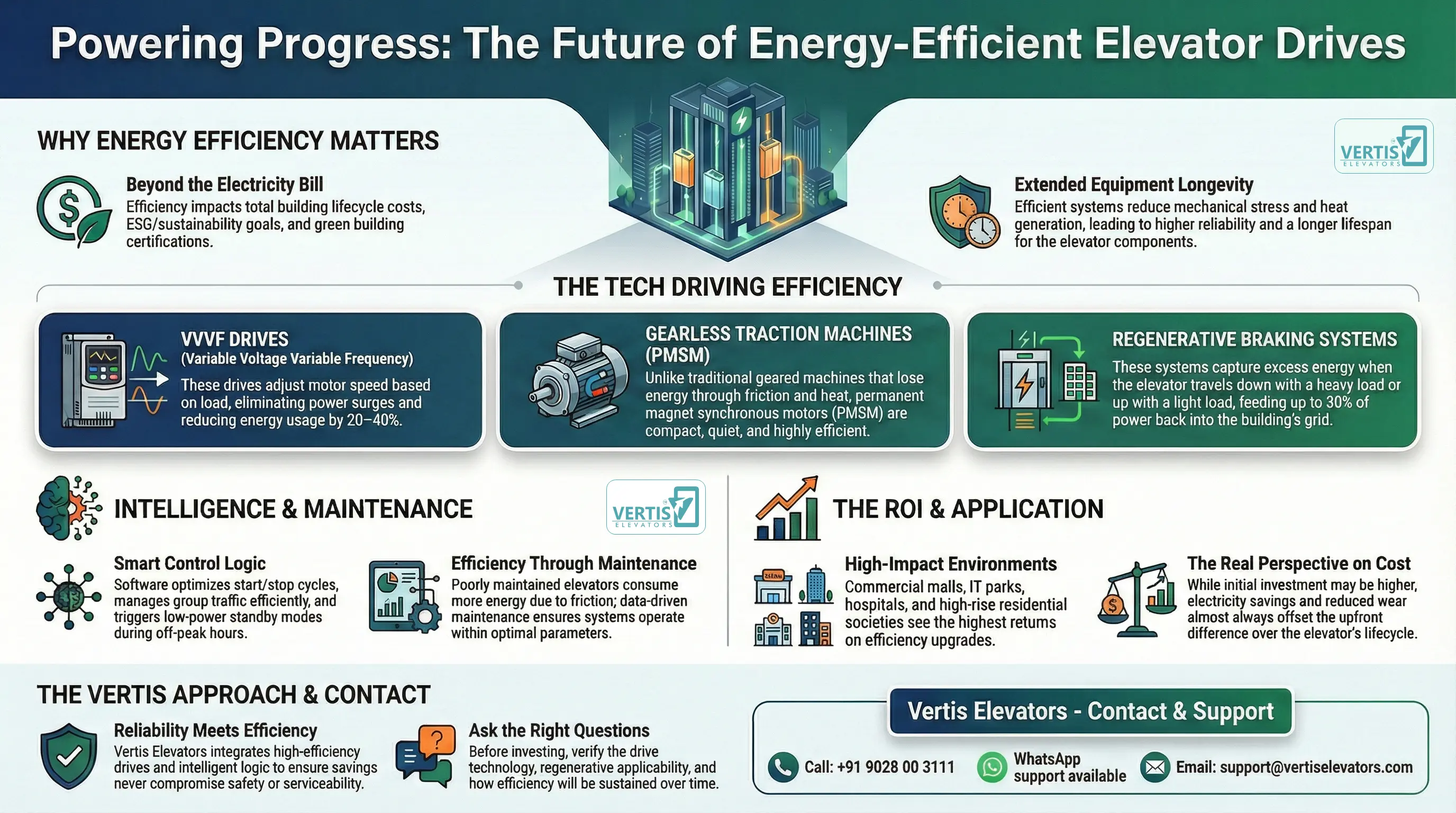
Why Elevator Energy Efficiency Matters More Than Ever?
Energy efficiency is no longer just about lowering electricity bills.
Today, it directly impacts:
- Operating costs over the building’s lifecycle
- ESG and sustainability goals
- Green building certifications
- Equipment longevity and reliability
For facilities that operate elevators continuously, even small efficiency gains translate into long-term savings.
Understanding Elevator Drive Systems (In Simple Terms)
The drive system is the heart of an elevator.
It controls how the motor starts, runs, accelerates, decelerates, and stops.
Older elevators typically used:
- Single-speed or two-speed motors
- Limited control logic
- High inrush current during startup
Modern elevators use intelligent variable-speed drives that optimize power usage at every movement.
VVVF Drives: The Foundation of Energy Efficiency
Most modern elevators today use VVVF (Variable Voltage Variable Frequency) drives.
What VVVF drives do differently:
- Adjust motor speed smoothly based on load and travel
- Eliminate sudden power surges
- Reduce mechanical stress on components
- Improve ride comfort
Energy impact:
- Lower peak power demand
- Reduced electricity consumption during acceleration
- Less heat generation
This alone can reduce elevator energy usage by 20–40% compared to older systems.
Gearless Traction Machines: Less Loss, More Efficiency
Traditional geared machines lose energy through:
- Mechanical friction
- Heat dissipation
- Wear-related inefficiencies
Modern gearless traction machines, especially permanent magnet synchronous motors (PMSM), offer:
- Higher efficiency
- Compact design
- Lower maintenance requirements
- Quieter operation
Because fewer mechanical losses occur, more electrical energy is converted into actual movement.
Regenerative Drives: Recovering Wasted Energy
One of the most impactful innovations in elevator efficiency is regenerative braking.
How it works:
When an elevator:
- Travels downward with a heavy load, or
- Travels upward with a light load
The motor acts as a generator instead of consuming power.
A regenerative drive:
- Captures this excess energy
- Feeds it back into the building’s electrical system
- Reduces net energy draw from the grid
In high-traffic buildings, regenerative systems can recover up to 30% of consumed energy.
Smarter Control Logic = Smarter Energy Use
Energy efficiency is not only about hardware.
Modern controllers use software intelligence to:
- Optimize start/stop cycles
- Reduce idle energy consumption
- Manage group control in multi-elevator systems
- Minimize unnecessary trips
For example:
- Elevators can enter low-power standby modes during off-peak hours
- Group systems distribute traffic efficiently instead of running all cars unnecessarily
These optimizations quietly save power every day.
Energy Efficiency and Maintenance Go Hand in Hand
An often-ignored fact: Poorly maintained elevators consume more energy.
Worn components cause:
- Increased friction
- Higher motor load
- Inefficient door operations
Data-driven maintenance ensures that:
- Systems operate within optimal parameters
- Energy losses due to wear are minimized
- Efficiency remains consistent over time
Which Buildings Benefit the Most from Energy-Efficient Elevators?
Energy-efficient elevator systems deliver the highest return in:
- Commercial malls and IT parks
- Hospitals with continuous operation
- Industrial facilities
- High-rise residential societies
- Buildings with multiple elevators
In such environments, efficiency improvements compound quickly.
Energy Efficiency vs Upfront Cost: The Real Perspective
Modern, energy-efficient elevators may involve:
- Slightly higher initial investment
- More advanced components
However, over the elevator’s lifecycle:
- Electricity savings
- Reduced wear and tear
- Lower maintenance strain
Almost always offset the upfront difference.
Energy efficiency is not an expense—it is risk reduction and cost control.
The Vertis Approach to Energy-Efficient Elevators
At Vertis Elevators, energy efficiency is treated as part of system reliability, not just sustainability.
By integrating:
- High-efficiency drive systems
- Premium traction machines
- Intelligent control logic
- Proper installation and tuning
Energy savings are achieved without compromising safety, serviceability, or lifespan.
Efficiency only matters when it is reliable.
Before Choosing an Energy-Efficient Elevator, Ask This
- Which drive technology is being used?
- Is regenerative braking applicable to my building usage?
- How will efficiency be sustained over time?
- Is the system aligned with my building’s actual traffic pattern?
Informed questions lead to informed investments.
Call: +91 9028 00 3111
(WhatsApp Support Available)
Email: support@vertiselevators.com
Related Post

Safety Can’t Wait.
Book a free safety audit with Vertis Elevators and ensure your building meets every standard - protecting people and your reputation.
Leave a Comment



Comments (0)
No comments available.