

Machine-Room-Less (MRL) Elevators: Benefits, Limitations & Ideal Use Cases
Machine-Room-Less (MRL) elevators have become one of the most talked-about elevator technologies in recent years. Many new buildings specify them by default; sometimes without fully understanding whether they are actually the right fit.
MRL elevators are not “better” in every situation.
They are better in the right situation.
This article breaks down what MRL elevators really are, where they work best, where they don’t, and how to decide responsibly.
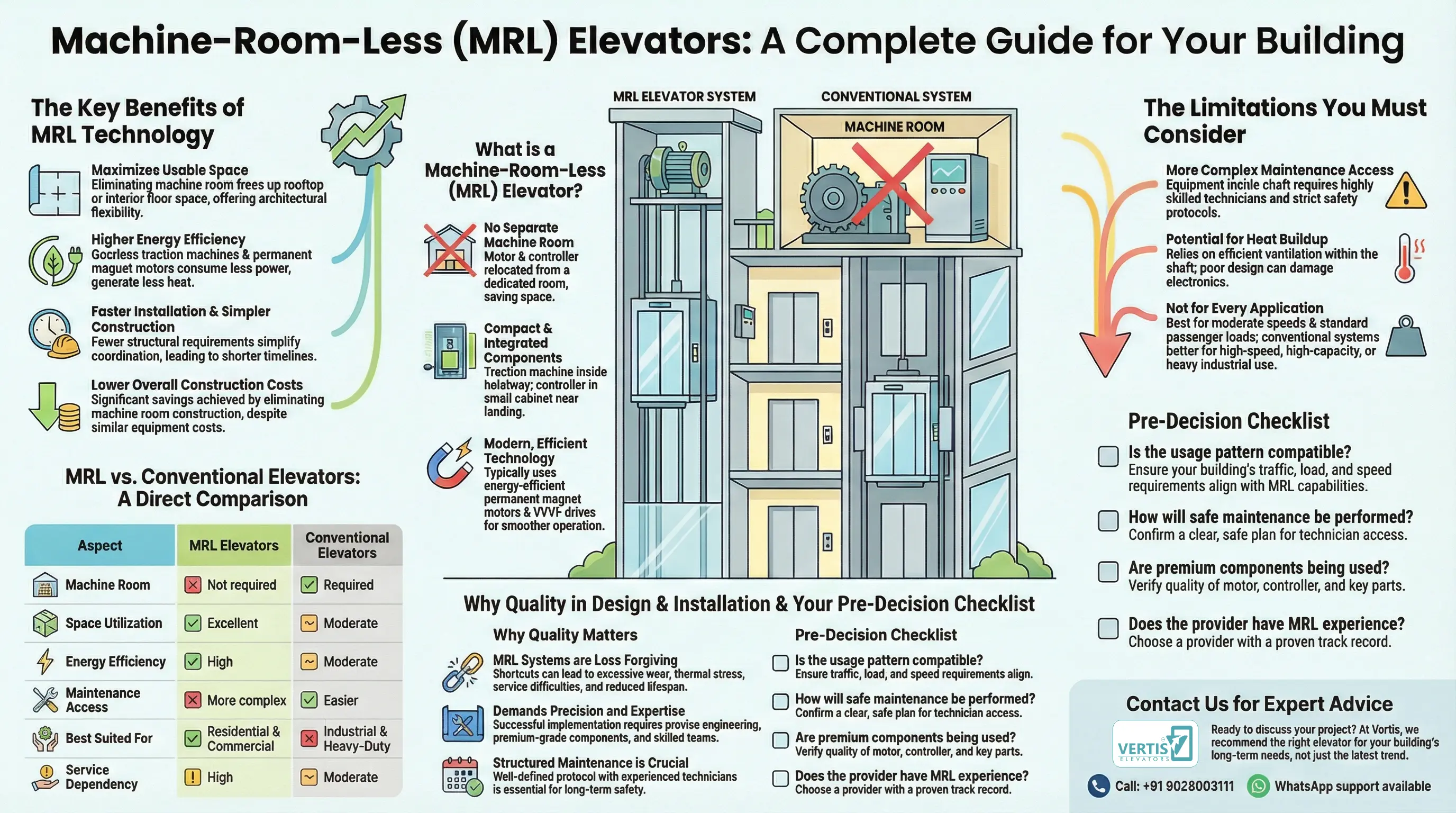
What Is a Machine-Room-Less (MRL) Elevator?
In a conventional elevator system, the motor and controller are housed in a separate machine room, usually above the shaft.
An MRL elevator eliminates this dedicated machine room.
Instead:
- The traction machine is installed within the hoistway
- The controller is placed in a compact cabinet near the landing
- Modern permanent magnet motors are used
The result is a space-efficient vertical transportation system.
Why MRL Elevators Became Popular
The rise of MRL elevators is driven by urban constraints and architectural priorities, not just technology.
Key reasons for adoption:
- Limited rooftop or building height allowances
- Increasing focus on usable floor space
- Faster construction timelines
- Energy efficiency improvements
For many projects, MRL elevators offer design flexibility that traditional systems cannot.
Key Benefits of MRL Elevators
1. Space Savings
Eliminating the machine room frees up:
- Rooftop space
- Additional usable area
- Architectural flexibility
This is particularly valuable in:
- Residential buildings
- Hospitals
- Commercial complexes with height restrictions
2. Energy Efficiency
MRL elevators typically use:
- Gearless traction machines
- Permanent magnet motors
- VVVF drives
These systems consume less power and generate less heat, improving overall efficiency.
3. Faster Installation
With fewer structural requirements:
- Construction coordination becomes simpler
- Installation timelines are often shorter
- Reduced dependency on civil readiness
This benefits fast-track commercial projects.
4. Lower Construction Costs (In Many Cases)
While equipment costs may be similar, savings come from:
- Eliminated machine room construction
- Reduced civil and architectural work
Total project cost often balances favorably.
The Limitations (Most Sales Brochures Don’t Mention)
MRL elevators are not without trade-offs. Understanding the following limitations upfront prevents long-term dissatisfaction.
1. Maintenance Accessibility
Since equipment is located within the shaft:
- Maintenance requires higher skill levels
- Access protocols must be strictly followed
- Improper servicing can compromise safety
This makes service expertise non-negotiable.
2. Heat Management
Machine-room-less designs rely heavily on:
- Efficient ventilation
- High-quality components
In poorly designed installations, heat buildup can impact electronics over time.
3. Load & Speed Constraints
MRL elevators are best suited for:
- Moderate speeds
- Standard passenger loads
For very high-speed, high-capacity, or heavy industrial lifts, conventional systems may still be more appropriate.
Where MRL Elevators Make the Most Sense?
MRL elevators are ideal for:
- Residential buildings
- Hospitals and healthcare facilities
- Commercial offices
- Hotels and institutional buildings
- Mid-rise structures with height limitations
They are less suitable for:
- Heavy-duty industrial freight elevators
- Extremely high-rise or high-speed applications
- Environments with poor maintenance access planning
MRL vs Conventional Elevators: A Practical Comparison
|
Aspect |
MRL Elevators |
Conventional Elevators |
|
Machine room |
Not required |
Required |
|
Space utilization |
Excellent |
Moderate |
|
Energy efficiency |
High |
Moderate |
|
Maintenance access |
More complex |
Easier |
|
Suitability |
Residential & commercial |
Industrial & heavy-duty |
|
Service dependency |
High |
Moderate |
Why Design & Installation Quality Matters More in MRL Systems?
MRL elevators are less forgiving of shortcuts.
Poor design decisions can lead to:
- Excessive wear
- Thermal stress
- Service difficulties
- Reduced lifespan
This is why MRL systems demand:
- Precise engineering
- Premium-grade components
- Skilled installation teams
- Structured maintenance protocols
The Vertis Perspective on MRL Elevators
At Vertis Elevators, MRL systems are recommended only after technical suitability is established.
Each project is evaluated based on:
- Usage pattern
- Load requirements
- Building constraints
- Long-term maintenance feasibility
The objective is not to install what is trending, but what is reliable, safe, and sustainable over decades.
An elevator should serve the building, not force the building to adapt to it.
Before You Choose an MRL Elevator, Ask These Questions
- Is my building usage aligned with MRL capabilities?
- How will maintenance access be ensured safely?
- Are premium components being used?
- Does the service provider have proven MRL experience?
Clear answers today prevent operational regrets tomorrow.
Call: +91 9028 00 3111
(WhatsApp Support Available)
Email: support@vertiselevators.com
Related Post

Safety Can’t Wait.
Book a free safety audit with Vertis Elevators and ensure your building meets every standard - protecting people and your reputation.
Leave a Comment



Comments (0)
No comments available.