

Elevator Safety Features Every Building Must Have
Because elevator safety is not about features — it’s about responsibility.
Introduction: Safety Is Not an Upgrade. It’s a Baseline.
Every day, elevators move thousands of people silently and efficiently. Because they work in the background, safety is often assumed — until something goes wrong.
The truth is simple:
Most elevator accidents are not caused by sudden failures. They happen due to missing, outdated, or poorly maintained safety systems.
This article outlines the essential elevator safety features that every building must have, regardless of size or usage — whether it’s a hospital, factory, mall, office, or housing society.
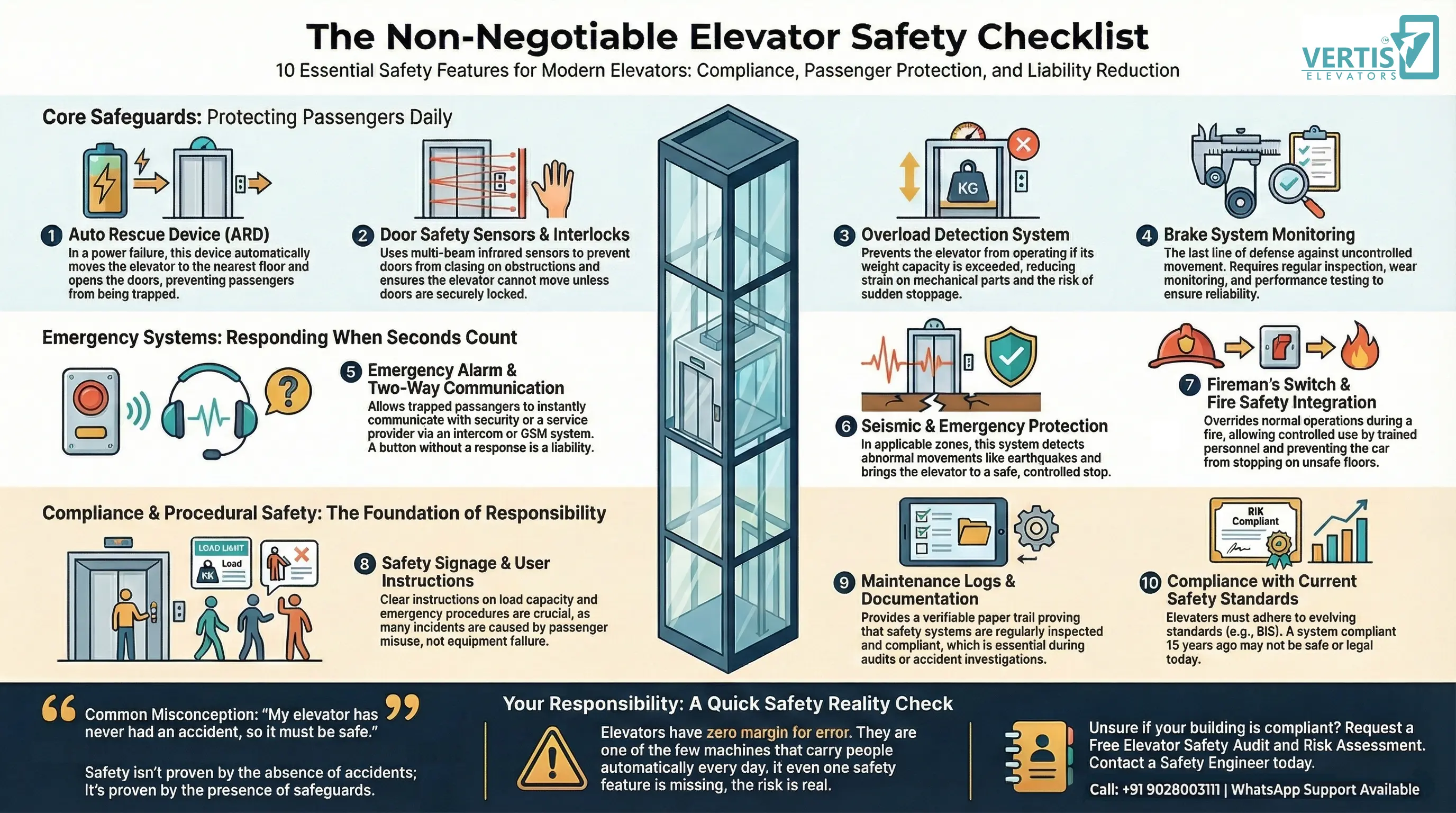
1. Auto Rescue Device (ARD)
What it does:
In the event of a power failure, the ARD automatically moves the elevator to the nearest floor and opens the doors.
Why it matters:
Without ARD, passengers can remain trapped during outages, causing panic, medical emergencies, and liability issues.
Non-negotiable for:
- Hospitals
- High-rise buildings
- Senior citizen and residential complexes
If your elevator stops between floors during power cuts, ARD is either missing or malfunctioning.
2. Door Safety Sensors & Interlocks
What they do:
Prevent doors from closing if there is any obstruction and ensure the elevator does not move unless doors are fully closed and locked.
Why it matters:
Door-related incidents are among the most common elevator accidents, especially in high-traffic buildings.
Modern systems include:
- Infrared multi-beam sensors
- Intelligent door reopening logic
If doors close abruptly or fail to detect obstructions, safety is compromised.
3. Emergency Alarm & Two-Way Communication System
What it does:
Allows trapped passengers to communicate with building security or service providers instantly.
Why it matters:
Being trapped without communication can escalate from inconvenience to emergency — especially for children, elderly passengers, or patients.
Must-have features:
- Audible alarm
- Two-way intercom or GSM-based communication
- 24x7 response integration
An emergency button that no one responds to is not a safety feature — it’s a liability.
4. Overload Detection System
What it does:
Prevents elevator operation if passenger or load capacity is exceeded.
Why it matters:
Overloading strains mechanical systems, increases wear, and raises the risk of sudden stoppage.
Critical for:
- Freight elevators
- Industrial plants
- Residential buildings during peak hours
If your elevator moves even when overloaded, it’s unsafe.
5. Brake System Monitoring & Testing
What it does:
Ensures that braking systems engage reliably during stops and emergencies.
Why it matters:
Brakes are the last line of defense against uncontrolled movement.
Best practice includes:
- Regular brake inspection
- Wear monitoring
- Performance testing under load
Brake failures are rare, but when they occur, the consequences are severe.
6. Fireman’s Switch & Fire Safety Integration
What it does:
Overrides normal elevator operation during fire emergencies and allows controlled use by trained personnel.
Why it matters:
Elevators must respond correctly during fires to avoid smoke-filled shafts and unsafe stops.
Essential in:
- Commercial buildings
- Malls
- Hospitals
- High-rise residential towers
Fire safety integration is not optional — it is mandated by modern building codes.
7. Seismic & Emergency Protection Systems (Where Applicable)
What they do:
Detect abnormal movement (such as earthquakes) and bring the elevator to a safe stop.
Why it matters:
In seismic zones or industrial environments, uncontrolled movement can cause severe damage and injury.
While not required everywhere, risk-based deployment is strongly recommended.
8. Safety Signage & User Instructions
What it does:
Guides passengers on correct usage and emergency behavior.
Why it matters:
Many incidents are caused not by equipment failure, but by misuse.
Must include:
- Load capacity signage
- Emergency instructions
- Contact information
Safety communication is as important as safety hardware.
9. Maintenance Logs & Safety Documentation
What it does:
Provides proof that safety systems are regularly checked and compliant.
Why it matters:
During inspections, accidents, or insurance claims, documentation protects building owners.
Every safe elevator leaves a paper trail of responsibility.
10. Compliance with Current Safety Standards
Elevator safety is governed by evolving standards such as:
- BIS (Indian Standards)
- Relevant fire and building regulations
- Manufacturer safety guidelines
An elevator that met standards 15 years ago may no longer be compliant today.
Safety is not static — it must be maintained and upgraded.
A Common Misconception to Avoid
“Our elevator has never had an accident, so it’s safe.”
Safety is not proven by the absence of accidents — it is proven by the presence of safeguards.
Key Takeaway
An elevator is one of the few machines that:
- Carries people daily
- Operates automatically
- Has zero margin for error
Every building has a responsibility to ensure its elevators are equipped, compliant, and maintained for safety — not just operation.
If even one of the above safety features is missing or outdated, the risk is real.
Call to Action
Unsure whether your elevators meet today’s safety expectations?
- Request a Free Elevator Safety Audit
- Get a Compliance & Risk Assessment
- Speak with a Vertis Safety Engineer today
Call: +91 9028 00 3111
WhatsApp Support Available
Email: support@vertiselevators.com
Related Post

Safety Can’t Wait.
Book a free safety audit with Vertis Elevators and ensure your building meets every standard - protecting people and your reputation.
Leave a Comment




Comments (0)
No comments available.